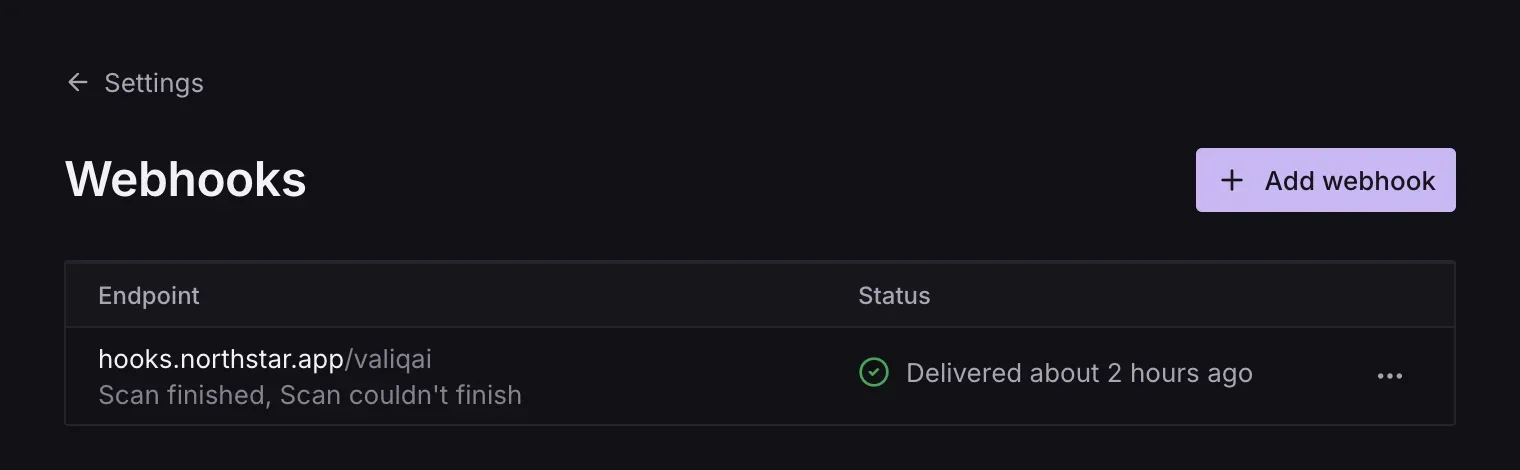
A webhook tells your server when a scan ends, so you don't have to poll. ValiqAI sends a signed POST to your address with what happened. Paths are under https://www.valiqai.com/api/v1; webhooks can also be managed in the app under Integrations › Webhooks.
Events
| Event | Sent when |
|---|---|
scan.completed | A scan finished, whatever it found. data.status is passed, failed, warning or partial. |
scan.failed | A scan couldn't finish. data.error says why. |
scan.cancelled | A scan was stopped, from the app, the API or the CLI. |
scan.started is accepted when you subscribe, for older integrations, but isn't sent.
A webhook gets events for the scans of its workspace: a team webhook, for the team's scans while the person who added it is on the team; a personal webhook, for every scan you start.
POST /webhooks
Adds a webhook. Scope webhooks.
{ "url": "https://example.com/hooks/valiqai", "events": ["scan.completed", "scan.failed"] }events defaults to ["scan.completed"]. A team key's webhooks belong to its team; a personal key can add a team webhook with organizationId if you're an owner or admin there.
{
  "webhook": {
    "id": "cmw1…",
    "url": "https://example.com/hooks/valiqai",
    "events": ["scan.completed", "scan.failed"],
    "secret": "9f2c…",
    "active": true
  },
  "message": "Webhook created successfully. Save the secret for signature verification."
}
The secret is shown only here. Store it, and use it to check each delivery's signature.
| Status | error |
|---|---|
| 400 | Webhook URL is required |
| 400 | Invalid URL format, or Invalid URL for a private or internal address |
| 400 | Invalid events: <list>. Valid events: scan.completed, scan.failed, scan.cancelled, scan.started |
| 403 | This is a team key; it can only add webhooks to its own team |
| 403 | Only team owners and admins can add a team webhook |
| 429 | Maximum 10 webhooks per user (per team, for a team key) |
GET /webhooks
Lists webhooks, oldest first, with how deliveries are going. Scope webhooks.
{
  "webhooks": [
    {
      "id": "cmw1…",
      "url": "https://example.com/hooks/valiqai",
      "events": ["scan.completed"],
      "active": true,
      "organizationId": "org_8f2…",
      "createdAt": "2026-10-20T12:00:00.000Z",
      "lastDeliveryAt": "2026-10-20T13:15:16.000Z",
      "lastStatus": 200,
      "failureCount": 0
    }
  ]
}
DELETE /webhooks
Removes one: DELETE /webhooks?id=<id>. Scope webhooks. Answers { "success": true }, or 404 Webhook not found.
Changing a webhook's events, turning it off and rotating its secret are in the app, under Integrations › Webhooks.
Deliveries
Each delivery is a POST with a JSON body:
{
  "id": "7f1d2c9e-0a3b-4f1e-9c2d-5b6a7e8f9012",
  "event": "scan.completed",
  "timestamp": "2026-10-20T13:15:16.000Z",
  "organizationId": "org_8f2…",
  "data": {
    "id": "cmh2x8k1p0",
    "event": "scan.completed",
    "status": "failed",
    "url": "https://staging.example.com",
    "score": 64,
    "findingsCount": 3,
    "pollUrl": "/api/v1/scans/cmh2x8k1p0"
  }
}organizationIdis the workspace the scan ran in.scoreandfindingsCountcome withscan.completed;errorcomes withscan.failedandscan.cancelled.findingsCountcounts blockers, high and medium findings. For the problems themselves,GETthe scan.idis the delivery's id, the same on every retry: use it to ignore a repeat.
| Header | What it is |
|---|---|
X-ValiqAI-Event | The event, like scan.completed. |
X-ValiqAI-Delivery-ID | The delivery's id, the same as the body's id. |
X-ValiqAI-Delivery-Attempt | 1, 2 or 3. |
X-ValiqAI-Signature | t=<unix seconds>,v1=<signature>. See below. |
User-Agent | ValiqAI-Webhook/1.0 |
Retries. A delivery succeeds when your server answers 2xx within 10 seconds. Otherwise it's tried again 30 seconds later, then 2 minutes after that: three attempts in all. Redirects aren't followed, so answer from the address itself. After 20 deliveries in a row fail, the webhook is turned off; turn it back on in the app.
Check the signature
The signature is an HMAC-SHA256, keyed with your webhook's secret, of the timestamp, a dot, and the raw request body. Check it on the raw body, before parsing it, and refuse a timestamp more than 5 minutes old:
import crypto from 'node:crypto';

/** True when a delivery is from ValiqAI. `rawBody` is the request body as received. */
export function verifyValiqaiSignature(rawBody, header, secret) {
  const parts = Object.fromEntries(header.split(',').map((p) => p.trim().split('=')));
  const t = Number(parts.t);
  if (!Number.isInteger(t) || !parts.v1) return false;
  if (Math.abs(Date.now() / 1000 - t) > 300) return false;
  const expected = crypto.createHmac('sha256', secret).update(`${t}.${rawBody}`).digest('hex');
  const a = Buffer.from(expected);
  const b = Buffer.from(parts.v1);
  return a.length === b.length && crypto.timingSafeEqual(a, b);
}
Each retry is signed again with a new timestamp, over the same body.
Per-scan callbacks
POST /scans also takes a webhook address for that one scan. When the scan ends, the address gets a POST with the data object above on its own, with the same headers and retries. It's signed only when the address is also one of your active webhooks; otherwise it's sent unsigned, so prefer a webhook.